
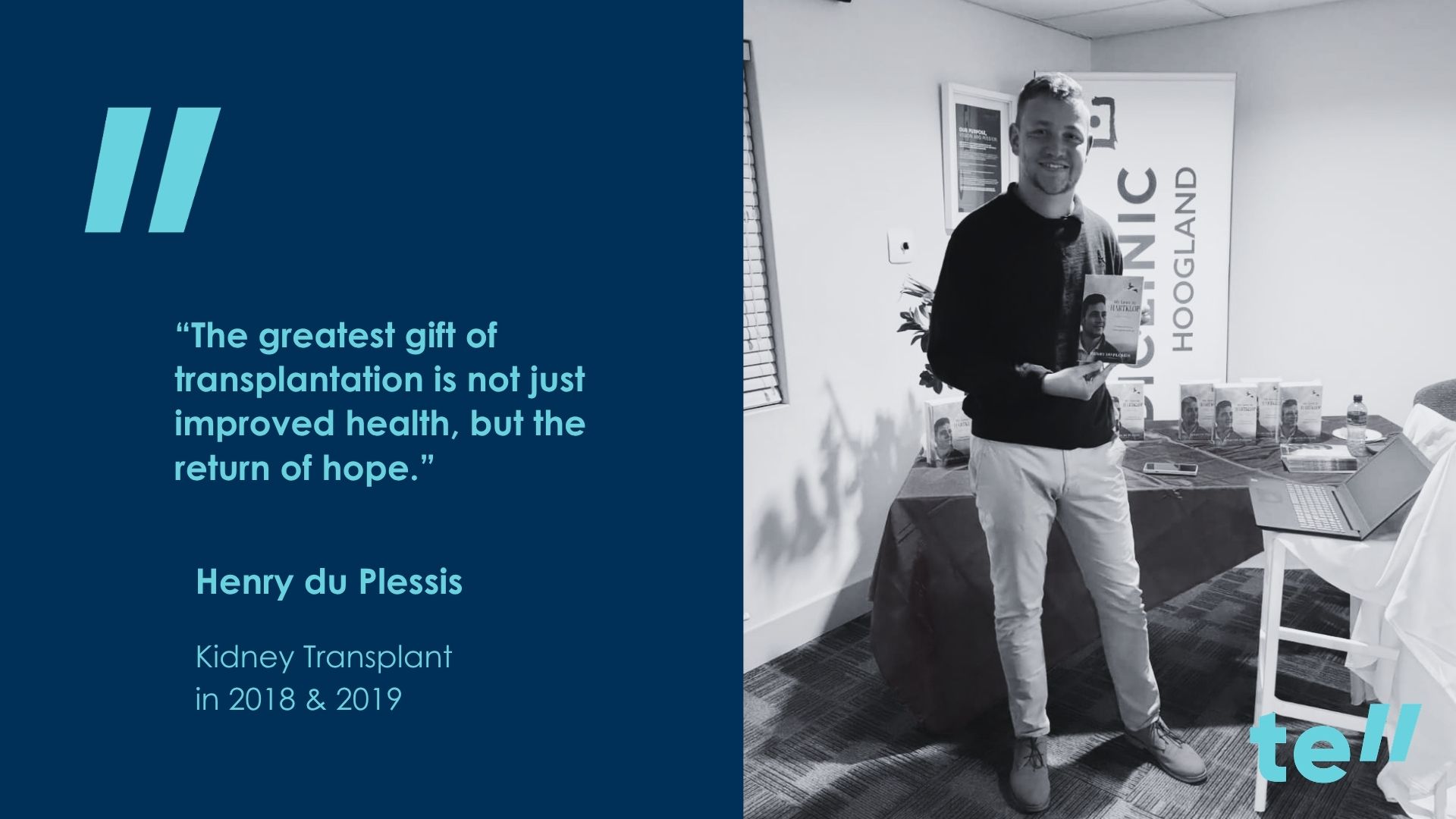
Kidney Transplant – Henry du Plessis
Henry du Plessis is a 27-year-old teacher from Bethlehem in the Free State. After being diagnosed with end-stage kidney failure
Henry du Plessis is a 27-year-old teacher from Bethlehem in the Free State. After being diagnosed with end-stage kidney failure during his matric year, Henry’s journey included dialysis, two kidney transplants, setbacks, and remarkable resilience. Today, he shares his story of faith, hope, and second chances.
1. When were you diagnosed with kidney failure, and what was the prognosis?
I was diagnosed with end-stage kidney failure in 2017, during my matric year. The doctors told me that my kidney function had dropped to around 6% and that I would need dialysis and eventually a kidney transplant.
2. What was life like before your transplant?
Life before my transplant was extremely challenging. My life changed almost overnight. I spent four hours at a time on dialysis, three times a week, and much of my life revolved around treatments, medical appointments, and managing my health.
At the time, I was still a young man with dreams and plans for the future, but kidney failure forced me to put many things on hold. There were days when I felt exhausted, frustrated, and uncertain about what lay ahead. Simple things that many people take for granted became difficult.
Despite the challenges, I tried to keep moving forward. I focused on my studies, spent time with family and friends, and held on to my faith. The support of my loved ones, especially my family, helped me through some of the darkest moments. While dialysis kept me alive, I longed for the opportunity to live a fuller and more independent life through transplantation.
3. Which organ did you receive, and when?
I received a kidney transplant in August 2018. The kidney was donated by my mother. Unfortunately, that transplant eventually failed, and I later underwent a second kidney transplant in 2019.
4. How long were you on the waiting list?
For my first transplant, I was not on a traditional waiting list for a deceased donor organ because my mother was identified as a living donor. However, there was still a long journey of medical tests, evaluations, and preparations before my transplant could take place. For my second transplant I was waitlisted for a year.
5. What happened with your first transplant?
My first kidney transplant never functioned as well as everyone had hoped. Over time, it became clear that the kidney was not working properly, and I eventually had to return to dialysis.
I am not certain of the exact medical reason or classification, and I do not know whether it was formally diagnosed as rejection. What I do know is that the transplant was unsuccessful, which was devastating after everything my family and I had been through.
Despite that disappointment, I remained hopeful and was later blessed with the opportunity to receive a second kidney transplant.
6. What emotions did you experience when your first transplant failed?
I was shocked and terrified. Up until that point, I had been focused on finishing school and planning my future. Suddenly, my life changed completely. I remember feeling overwhelmed, confused, and afraid of what lay ahead.
One of the hardest things to process was the uncertainty. I did not know what dialysis would be like, whether I would be able to finish school, or what my future would look like. It felt as though my dreams and plans had been placed on hold overnight.
Looking back, it was one of the most frightening moments of my life. At the same time, it was the beginning of a journey that taught me resilience, faith, gratitude, and the value of every day that I have been given.
7. How did you feel when you received the call for your second transplant?
I experienced a flood of emotions. More than anything, I was afraid.
Having already gone through kidney failure, dialysis, a transplant, and then the loss of that transplant, I understood how much was at stake. I was afraid of the unknown, afraid of complications, and afraid of allowing myself to hope too much.
At the same time, I felt grateful and relieved. The call represented another chance at life and another opportunity to move forward. I remember feeling overwhelmed as I tried to process everything that was happening.
Looking back, I realise that fear and hope existed side by side in that moment. While I was scared of what lay ahead, I was also deeply thankful for the opportunity to receive a second transplant and for the people who made that second chance possible.
8. What is life like now after your transplant?
Life after my transplant is very different from what it was during kidney failure and dialysis. While I still have regular medical check-ups and need to take medication every day, I have been given the opportunity to live a much fuller and more independent life.
Today, I am able to work as a teacher, spend time with family and friends, and make plans for the future. Many of the things that once seemed impossible during my years on dialysis are now possible again.
Perhaps the greatest gift of transplantation is not just improved health, but the return of hope. It has allowed me to dream again, set goals, and appreciate life in a way I never did before. My journey has taught me not to take a single day for granted.
Every day is a reminder of the incredible gift of organ donation and the second chance at life that transplantation has given me.
9. What advice would you give other patients going through rejection or transplant complications?
There will be days when you feel discouraged, frightened, or overwhelmed. It is normal to experience a wide range of emotions when something so important to your future is uncertain. Allow yourself to feel those emotions, but do not face them alone. Lean on your family, friends, medical team, and support network.
I would also encourage patients to ask questions and stay actively involved in their treatment. Understanding your condition can help you feel more in control during a difficult time.
Most importantly, remember that rejection or transplant complications do not mean the end of your journey. My first transplant was unsuccessful, and I eventually had to return to dialysis. At the time, it felt devastating, but I was later blessed with the opportunity to receive a second kidney transplant.
Hold on to hope. Even when the road ahead seems uncertain, there can still be new opportunities, new treatments, and new beginnings.
10. What advice would you give patients on the waiting list?
Waiting can be one of the most difficult parts of the transplant journey. There are often many uncertainties, and it can be emotionally exhausting. Some days may feel overwhelming, but it is important not to lose sight of the fact that every day brings you one step closer to the possibility of a transplant.
While you wait, focus on taking care of your health, following your medical team’s advice, and spending time with the people who matter most. Lean on your support system and do not be afraid to ask for help when you need it.
Most importantly, remember that you are more than your illness. A transplant can give you a second chance at life, but do not put your life completely on hold while you wait. Continue to dream, set goals, and make memories.
I know from personal experience that the journey can be long and challenging, but I also know that hope can carry you through some of the darkest moments.
11. Why do you think there is a shortage of organ donors in South Africa?
I believe one of the main reasons for the shortage of organ donors in South Africa is a lack of awareness and understanding. Many people do not know enough about organ donation, how it works, or the lives that can be saved through it.
There are also many misconceptions and fears surrounding organ donation, which can prevent people from registering as donors or discussing their wishes with their families. In many cases, people simply never think about organ donation until they or someone they love needs a transplant.
My own journey has shown me how life-changing organ donation can be. Because of transplantation, I have been given the opportunity to continue my life, pursue my career, and plan for the future. I believe that greater education, awareness, and open conversations about organ donation could help more people consider becoming donors and ultimately save more lives.
12. If you could describe transplant in one word, what would it be?
Hope.
A transplant gives people the hope of a future, a better quality of life, and the opportunity to dream again.
Read More
Henry du Plessis is a 27-year-old teacher from Bethlehem in the Free State. After being diagnosed with end-stage kidney failure
Helmut Ludwig is a 69-year-old kidney transplant recipient and avid cyclist living south of Simon’s Town at Castle Rock near
Transplant Tuesdays: Mario’s Heart Transplant Story At 31, Mario Nobrega, from Cape Town spent over a year on the transplant

On #TransplantTuesday, we share the story of this tiny heart warrior, whose family’s dreams of first smiles and first steps