New Transplant Breakthroughs Meet South Africa’s Donor Shortage This Orgust
As new technologies expand what is possible for South African patients, TELL says the conversation every family can have today is still what saves lives.
This August, or “Orgust” as National Organ and Tissue Donation Awareness Month has come to be known, new medical breakthroughs are meeting an old problem. South African transplant teams now offer options that did not exist a decade ago, yet the country’s organ donation rate remains among the lowest in the world, at less than 1.4 deceased donors per million population. Thousands of South Africans, including children, are waiting for a transplant right now, and TELL’s message this Orgust is simple: the conversation is what saves lives.
A transformative gift
When Mohamed Zayd Khota was one year and nine months old, kidney failure put his life on a strict, unforgiving schedule: sixteen hours of dialysis overnight, 21 medications, weekly injections, and a mother who became his full-time nurse. He could not go to school, play sport, or even drink a glass of water without weighing the consequences. In July 2025, after five years on the transplant waiting list, eight-year-old Mohamed Zayd received a kidney from a living donor. Today he goes to school, swims, and goes on holiday. He calls it “a wonderful gift”, and describes his transplant in one word: transformative.
Decades of progress most people never see
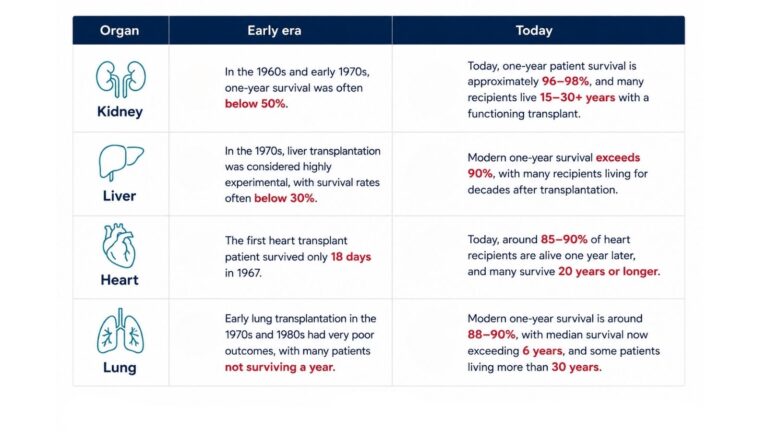
Mohamed Zayd’s recovery is only possible because of decades of progress. The first successful kidney transplant took place in 1954, when doctors had little way to stop rejection and most grafts failed within months. Survival has improved steadily across every transplant type since, most strikingly in lung transplantation, where median survival now reaches 6.7 years. Over the past 25 years, transplantation is estimated to have saved more than 2 million life-years worldwide.
South Africa is writing its own chapter of that progress. Surgeons are now transplanting kidneys and livers across blood group barriers that would once have ruled a donor out entirely. Where a mismatch cannot be safely bridged this way, a kidney exchange programme offers another route: two incompatible donor-recipient pairs are matched with each other, so each patient still receives a compatible kidney, in simultaneous surgery. And in June 2026, a South African transplant unit introduced Africa’s first liver perfusion machine, keeping a donor liver viable for longer outside the body, so surgeons can assess and even improve it before transplant, sometimes allowing a single liver to be split between a child and an adult patient.
Fawn Kruger, Co-founder and double lung transplant recipient, TELL:
“We are living in an era where transplantation is achieving things that would have seemed impossible just a decade ago. South African patients now have access to world-class transplant expertise and innovative treatments that are expanding opportunities for transplantation. But every breakthrough still depends on the generosity of donors and their families.”
Where South Africa falls short:
One organ donor can save up to seven lives, and tissue donation from that same donor can improve the lives of up to 70 more people.
That potential is where South Africa falls short. Its donation rate remains among the lowest in the world, at less than 1.4 deceased donors per million population. Patients with blood group O wait 12 to 15 years on average for a kidney transplant, and many die before a match is found. It is a strange position for a country that performed the world’s first human heart transplant in 1967, nearly 60 years ago: six decades of that head start have not translated into donor numbers. Spain, the world’s leading country for organ donation, sustains more than 40 donors per million population through sustained public education, government backing, and a transplant coordinator in every ICU. South Africa currently has only 23 transplant coordinators in total.
Stella de Kock, Managing Director, TELL:
“A machine can’t fix a system that doesn’t refer potential donors in time, or a family that’s never had the conversation, or a myth that stops someone from saying yes. This Orgust, we’re asking South Africa to address all of it, starting with the conversation every family can have today.”
Why the system fails
That failure takes several forms, not any single cause:
Potential donors are not always referred, or are referred too late, to a transplant coordinator.
– Families are often asked to decide on donation without ever having discussed it with their loved one, so they do not know what that person wanted, or they decline out of uncertainty.
– Hospitals are stretched, since every potential donor needs an ICU bed and a dedicated team.
– Myths about donation persist, among healthcare professionals as well as the public, affecting whether potential donors are referred at all.
The conversation is what saves lives
This is why TELL’s message this Orgust is simple: the conversation is what saves lives. Whether donation goes ahead is decided by your family, at the time of your passing, so if they do not know what you want, they cannot honour it. TELL is asking every South African to do the one thing that actually matters: tell your family today.
Mohamed Zayd Khota, kidney transplant recipient:
“We need to educate our youth on this important issue, so that we have more donors.”
How far we’ve come
This Orgust, have the conversation: tell your family your wishes today. The conversation is what saves lives. Learn more at tell.org.za. #Orgust