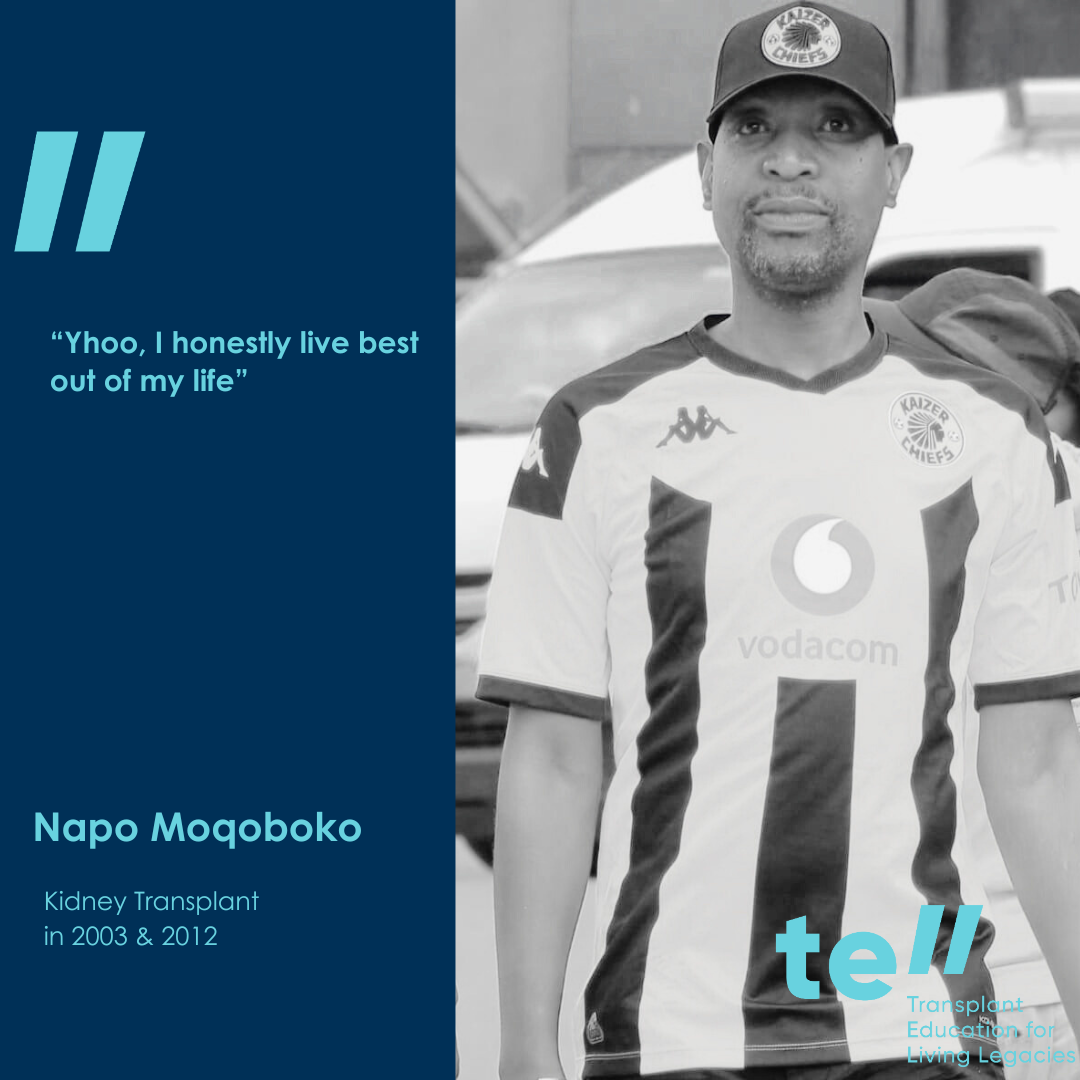
Napo Moqoboko, 41, from Ivory Park, Midrand.
1. Which organ did you receive, and in what year?
My first kidney transplant was in 2003 at the age of 19 and the second was in 2012.
2. How long were you on the waiting list for your organ?
For my first transplant I waited 1.5 years and the second transplant waited for 2 years.
3. What was life like before the transplant How did you spend your days?
It was really difficult shuffling between school and dialysis. Initially, I was on peritoneal dialysis (PD). It was hard having to change 4 bags daily while I had to attend classes at university. I later did haemodialysis, which required me to go to the hospital 3 times a week.
I think haemodialysis was the hardest; I always felt tired afterwards and had to be indoors most of the time. One had to follow a certain diet, which was really difficult considering my age at the time and the availability of certain meals at home. I constantly questioned God, and had to go through emotional turmoil until I accepted the status quo. I must mention the unconditional support that I got from my family that got me through everything. I certainly wouldn’t have pulled through without their support!
4. When did you go into rejection and do you know what type of rejection it was?
My first kidney transplant from a deceased donor lasted 8 years before being rejected in 2011 due to hydronephrosis (urethral blockages). My urea and creatinine started shooting up, I got started swelling and eventually the biopsy confirmed my rejection. The kidney was removed and I had to start hemodialysis.
5. What emotions did you experience when you received the diagnosis (chronic rejection)?
It was sad and hurtful to think that one has to back to dialysis again. I was just overwhelmed with anxiety, dejection and misery.
6. What was your prognosis, and did the treatment plan include another transplant?
Hydronephrosis is a condition characterised by the dilation of the renal pelvis and calyces due to the accumulation of urine, which was my prognosis. Yes, the treatment included being put on the transplant list.
7. What advice would you give other patients going through rejection?
To have a resilient mindset even when faced with utmost adversity. Believe in the process and keep on going irrespective of the circumstances. Just follow the treatment plan accordingly.
8. Describe the emotions experienced when you were told your donor is a match?
Well, we went through test after tests and eventually we were told it’s a match. I was told that there’s a possibility that the kidney may reject me immediately so I had a choice to either go through with it or decline. I looked at my sister and she said “Let’s do it, if that’s the last thing to safe you life”. We both grabbed the bull by its horns and did it. As they say “the rest is history”. The feeling was overwhelming; I was ecstatic and scared at the same time.
9. What is life like now, after the transplant?
Yhoo, I honestly live the best out of my life. I live my life like a normal person, I feel great and confident, and I no longer get admitted to hospital as I used to, and in fact I hardly go to the hospital except on clinic dates. The only time I remember that I’m transplanted is when I take my immunosuppressives, which I do daily in the morning and evening.
10. What advice would you give patients on the waiting list?
To believe in the process and never lose hopes even have faced with utmost adversities they need to keep soldiering on. Yeah! They are warriors!
11. Why do you think there is a shortage of donors in South Africa?
Indeed, if certainly feel like there isn’t sufficient education and funding towards initiatives and awareness of organ donation.
12. If you could describe transplant in one word, what would it be?
Organ transplant is a CALLING!